- English
- French
- German
- Portuguese
- Spanish
- Russian
- Japanese
- Korean
- Arabic
- Greek
- German
- Turkish
- Italian
- Danish
- Romanian
- Indonesian
- Czech
- Afrikaans
- Swedish
- Polish
- Basque
- Catalan
- Esperanto
- Hindi
- Lao
- Albanian
- Amharic
- Armenian
- Azerbaijani
- Belarusian
- Bengali
- Bosnian
- Bulgarian
- Cebuano
- Chichewa
- Corsican
- Croatian
- Dutch
- Estonian
- Filipino
- Finnish
- Frisian
- Galician
- Georgian
- Gujarati
- Haitian
- Hausa
- Hawaiian
- Hebrew
- Hmong
- Hungarian
- Icelandic
- Igbo
- Javanese
- Kannada
- Kazakh
- Khmer
- Kurdish
- Kyrgyz
- Latin
- Latvian
- Lithuanian
- Luxembou..
- Macedonian
- Malagasy
- Malay
- Malayalam
- Maltese
- Maori
- Marathi
- Mongolian
- Burmese
- Nepali
- Norwegian
- Pashto
- Persian
- Punjabi
- Serbian
- Sesotho
- Sinhala
- Slovak
- Slovenian
- Somali
- Samoan
- Scots Gaelic
- Shona
- Sindhi
- Sundanese
- Swahili
- Tajik
- Tamil
- Telugu
- Thai
- Ukrainian
- Urdu
- Uzbek
- Vietnamese
- Welsh
- Xhosa
- Yiddish
- Yoruba
- Zulu
Hog Dehairing Tank Washer: How High Pressure Improves Cleaning Efficiency
A hog dehairing tank washer is an industrial cleaning device designed for use in slaughterhouses and meat processing industries to clean dehairing tanks after each processing cycle by removing hair, organic waste and pollutants. Dehairing tank cleaning is a high-pressure technology in the current era, and it is this high pressure which propels the water into surface pits and joints where human scrubbing just cannot reach. The Homey Wonbond hog dehairing tank washer removes sticky residue faster and with less water than conventional low-pressure options at 35 bar, helping plant supervisors fulfil HACCP audit requirements and maintain throughput without adding labour.
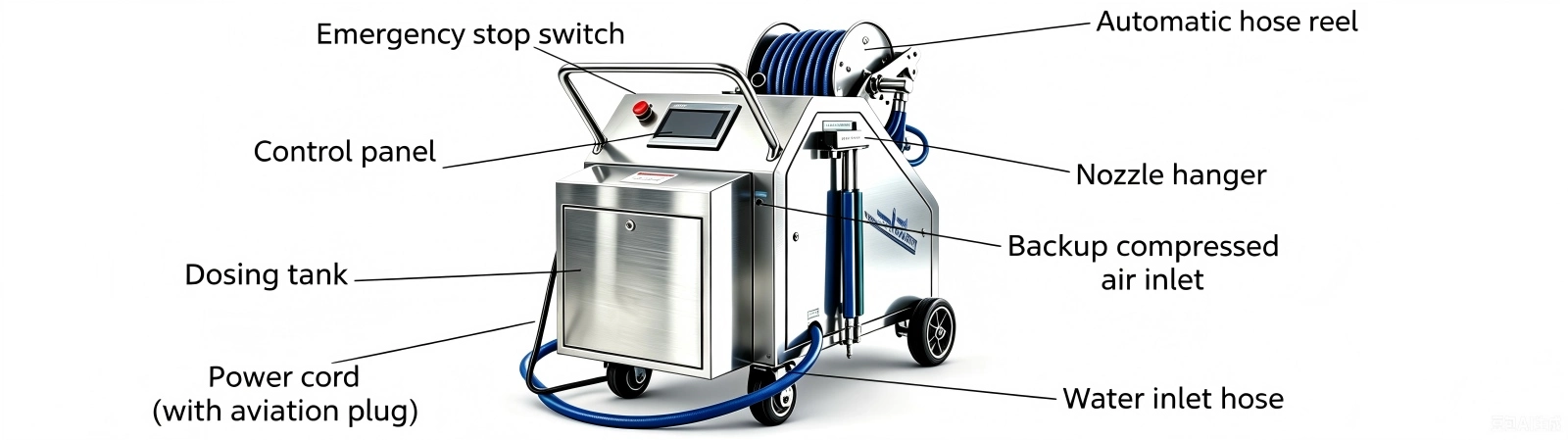
Understanding Hog Dehairing Tank Washers and Their Cleaning Mechanism
How the High-Pressure Wash Cycle Works
A hog dehairing tank washer uses custom designed nozzles inside the scalding and dehairing tank for the pressurised water . Between 60 and 70 °C, biofilm layers, hair pieces and scale deposits accumulate. These layers can be sliced through by water jets at 35 bar. With the mechanical force you don't have to soak the tanks for a long period or scrub them by hand. This halves the time needed to clean the entire tank compared to prior methods.
Key Components That Enable Effective Cleaning
The main features of a decent dehairing tank washer are high-pressure nozzles with adjustable angle, a flexible 25-meter hose, a frame of welded valve protection, and a handle with the functions of flushing water, applying foam and cleaning with spray. Cleaning agents in food-grade environments are hard on SUS 304 stainless steel as it does not react with them. Precise nozzle geometry and material integrity work together to ensure that any dead spots in the tank geometry are covered by all cleaning passes.
Why Temperature and Pressure Work Together
Scalding tanks work at temperatures between 60 °C and 70 °C, and the heat that stays in the tank while it's being cleaned helps the pressure washing process. High pressure sprays are effective with minimal dwell time to remove fat and protein layers on warm surfaces. The Homey Wonbond hog dehairing tank washer can operate at temperatures as high as 70 °C, so workers don’t have to wait for the tank to cool down before beginning the cleaning process. This safeguards the hygiene timeframe and scheduling efficiency.
Key Benefits of Using High-Pressure Hog Dehairing Tank Washers
When plant managers move from manual or low-pressure methods to a dedicated high-pressure hog dehairing tank washer, they always see improvements in three areas: speed, cost control, and trust in following the rules. Here are the main ways that this gadget makes things easier:
- Water savings up to 40%: The patented small-aperture nozzle design (Patent No. ZL201822250Q21.X) concentrates water flow at high velocity rather than high volume. Independent testing shows this approach cuts water consumption by approximately 40% compared to conventional hose-down methods, directly reducing utility costs in facilities that run multiple cleaning cycles per shift.
- Low power draw with high output: Running on 220 V / 1.5 kW, the hog dehairing tank washer delivers 35 bar of washing pressure without the heavy electrical infrastructure that larger fixed systems demand. For plants where energy budgets are closely monitored, the power-to-performance ratio matters every day.
- 3-in-1 operation from a single handle: Operators switch between high-pressure flushing, foam spraying, and disinfection without changing equipment. This cuts transition time between cleaning phases and removes the need to store multiple machines across a busy processing floor.
- Mobility across compartments: The unit weighs 148 kg and uses quick-connect fittings, so it moves between dehairing areas, scalding bays, and processing floors without requiring a fixed installation permit or downtime for setup.
These benefits directly address the two main issues that plant managers bring up most often: the growth of scale in the dehairing tank and the high cost of HACCP audit fails that happen after cleaning.
Meeting Halal and HACCP Cleaning Standards
Facilities that focus on exports are looked at more closely. Both Halal cleaning protocols and HACCP cleanliness standard operating procedures say that the hog dehairing tank must be washed thoroughly between processing runs to get rid of all organic waste. This is possible with the Homey Wonbond system's foam-application mode, which evenly spreads food-grade soap across the tank's surfaces before the high-pressure rinse phase gets rid of all traces.
Troubleshooting Common Problems and Maintenance Tips
Addressing Scale Buildup in Dehairing Tanks
Scale buildup is the most common operational complaint from slaughterhouse supervisors who are in charge of scalding equipment. Protein leftovers and hard water deposits stick together to make a cemented layer that makes the heat transfer in the tank less effective and gives bacteria a place to live. Running an acidic foam cleaner through the foam-spray mode before the high-pressure wash cycle gets rid of mineral deposits before they cause damage to the structure. In places with a lot of work, this acid wash should be done at least once a week.
Preventing Nozzle Clogging and Pressure Drops
Most pressure drops in high-pressure cleaning systems are caused by clogged nozzles. At the start of each shift, check the openings in the nozzles and flush the hose line before joining it to the cleaning lance. The Homey Wonbond hog dehairing tank washer doesn't have the loose connections that are common on cheaper units. Instead, it has welded ball-valve threading that stops pressure loss in the middle of the cycle. If one of the nozzles gets jammed, don't worry—have an extra set on hand.
Operator Safety During High-Pressure Washing
When the water gun is set to 35 bar, it has enough force to hurt people if it hits them. Before beginning any cleaning cycle, operators must put on safety gear that is waterproof, face shields, and shoes that won't slip. The comfortable single-handle design keeps the operator from getting tired after long shifts, and the 25-meter hose length lets the operator stand far enough away from the tank interior to work safely. Huamei Wanbang comes with documentation for operator training and remote technical support 24 hours a day, 7 days a week.
Comparing High-Pressure Hog Dehairing Tank Washers with Alternative Methods
Manual Cleaning vs. Automated High-Pressure Washing
Workers use brushes, scrapers, and small tools to clean dehairing tanks by hand. It takes a lot of time, is hard on the body, and doesn't always give the same results. A 2019 study in the Journal of Food Protection found that cleaning food-contact surfaces by hand left organic waste on more than 30% of samples, but high-pressure automatic methods cut that rate by a large amount. For places with 30 to 100 workers per shift, automatic pressure washing also moves workers from cleaning to making things instead.
Semi-Automated Options and Their Limitations
Some cleaning steps are done quickly by semi-automated systems, but nozzle adjustment and chemical doses still need to be done by hand. They work for small tasks, but when output goes up, they become a bottleneck. A 50-meter-long mobile hog dehairing tank washer with quick-connect lines can reach as far as a stable system and doesn't cost as much to set up.
Return on Investment Comparison
When looking at the total cost of ownership, the Homey Wonbond unit's 1.5 kW power need and 40% water savings lead to lower operating costs within the first quarter of use. When combined with the 14-working-day arrival time for custom setups, this means that procurement teams can plan how to integrate equipment without having to wait for long periods of line downtime.
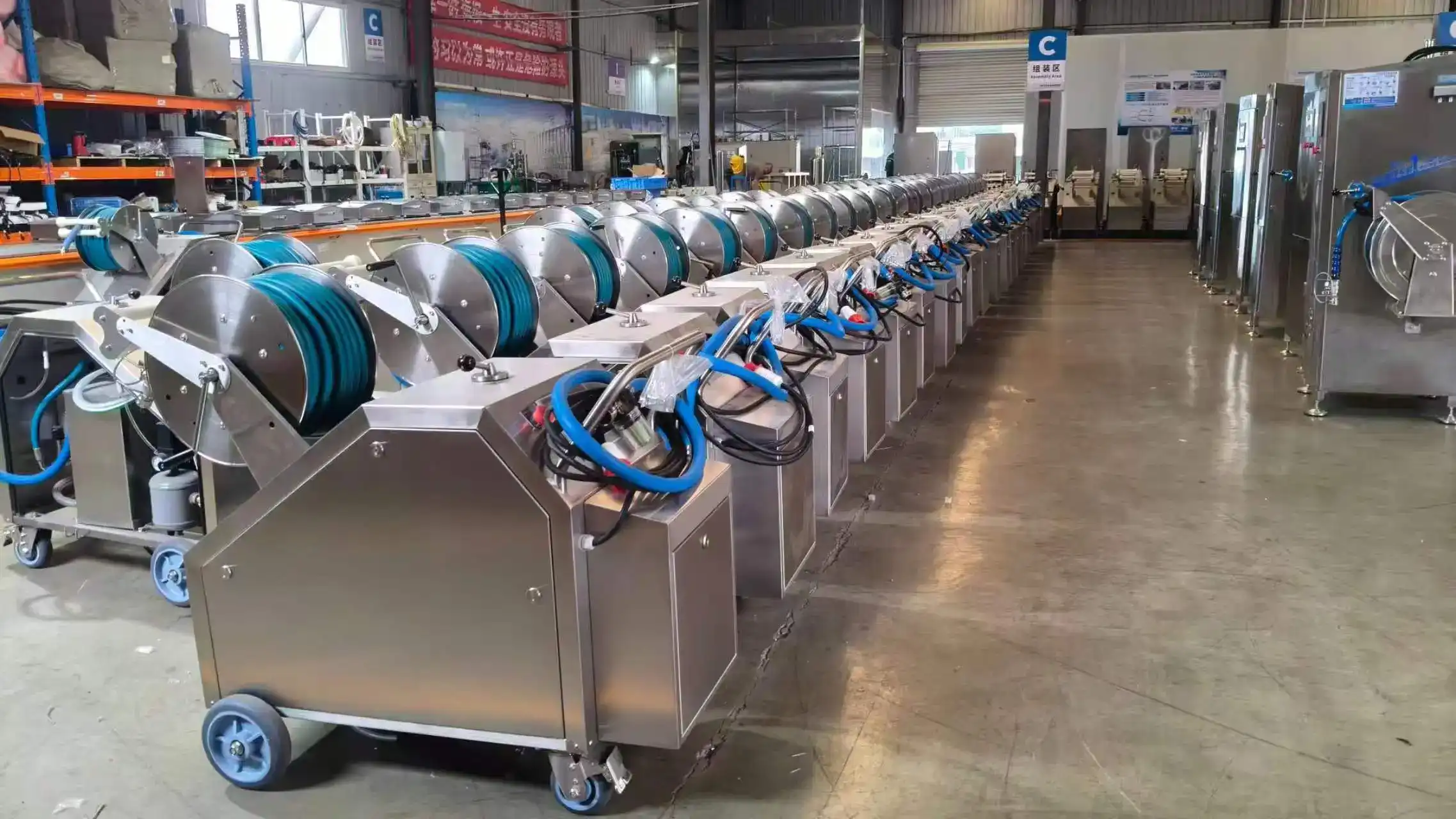
Procurement Guide: How to Choose and Buy the Right Hog Dehairing Tank Washer
Technical Specifications to Evaluate
Before you send out a buy order, make sure that the hog dehairing tank washer will work in your plant. Some important factors are the washing pressure (at least 35 bar for effective dehairing tank cleaning), the material grade (SUS 304 for food-grade compliance), the hose's reach compared to the size of your tank, and the temperature rating it can work at. In its standard form, the Homey Wonbond model covers all four.
Supplier Reliability and After-Sales Support
Support after the sale is the second most important thing that people in the slaughter industry say they look for in equipment. Make sure that your provider gives written warranty terms, access to spare parts, and expert support. Homey Wonbond offers online technology support 24 hours a day, seven days a week, as well as on-site installation help and a full package of consumables that includes disinfectants and cleaning products that work with the system.
Compliance Documentation for Export Facilities
When a facility sends food to another country, it has to make sure that its cleaning methods and tools are in line with that country's food safety rules. The CE mark and ISO 9001 quality control standards were used to make the Homey Wonbond hog dehairing tank washer. Customers who want to get Halal, FDA, or EU food safety approvals should make sure the certificate is still good and add more paperwork before finishing the purchase.
Conclusion
High-pressure cleaning has become the usual way to keep dehairing tanks in modern slaughterhouses in good shape because it improves the quality of the cleaning, the amount of water used, and compliance with regulations. The Homey Wonbond hog dehairing tank washer has a proven 35-bar pressure output, is made of SUS 304 steel, is mobile, and uses unique water-saving nozzle technology. It meets the daily needs of plant managers who are in charge of busy processing lines. This equipment is made to do the job, whether it's to pass a HACCP audit, meet Halal export standards, or just keep scale from building up between shifts.
FAQ
1. What pressure level does a dehairing tank washer need to clean effectively?
It is standard practice in the industry to use at least 30 bar to clean the surfaces of boiling tanks of hair and organic matter.
2. Is SUS 304 stainless steel required for dehairing tank cleaning equipment?
The Homey Wonbond hog dehairing tank washer works at 35 bar, which is high enough for both normal and high-residue cleaning.
3. Can one machine handle both cleaning and disinfection?
With just one handle, the Homey Wonbond machine can be used in three different modes: high-pressure water flushing, foam soap application, and spray cleaning. This gets rid of the need for different tools in each area of a processing floor with more than one zone.
Contact Homey Wonbond — Your Trusted Hog Dehairing Tank Washer Supplier
Since 2011, Homey Wonbond has provided food preparation plants on several countries. Our hog dehairing tank washer is made with unique water-saving technology, CE-certified construction, and meets ISO 9001 manufacturing standards. It is a mobile unit that ships quickly and works well under daily production pressure. Get in touch with our team right away if you're looking for a hog dehairing tank washer maker with a history of good customer service after the sale. You can get details, prices, or a chat about customizing your order by going to hmwbcleaning.com or emailing frank@hmwbcleaning.com.
References
1. Journal of Food Protection — "Efficacy of High-Pressure Washing in Reducing Microbial Contamination on Food Contact Surfaces," 2019.
2. Meat Science — "Hygiene Standards and HACCP Implementation in Modern Pork Processing Facilities," 2021.
3. Food Control — "Halal Slaughter Practices and Sanitation Protocol Requirements in Export-Oriented Abattoirs," 2020.
4. Biosystems Engineering — "Energy and Water Consumption Analysis of Automated Cleaning Systems in Livestock Processing Plants," 2018.
5. Journal of Cleaner Production — "Water Conservation Strategies in Industrial Food Processing Through High-Pressure Low-Volume Washing Technology," 2022.
6. Comprehensive Food Reviews International — "Regulatory Compliance Frameworks for Meat Processing Equipment in EU and U.S. Export Markets," 2023.
Learn about our latest products and discounts through SMS or email